
Walking & Comfort
How to choose a fixed-length clip, slip or retractable dog lead
Plan for the busiest part of the route first. Check how the lead attaches, how much distance it gives your dog and where the pressure goes if the line pulls tight.
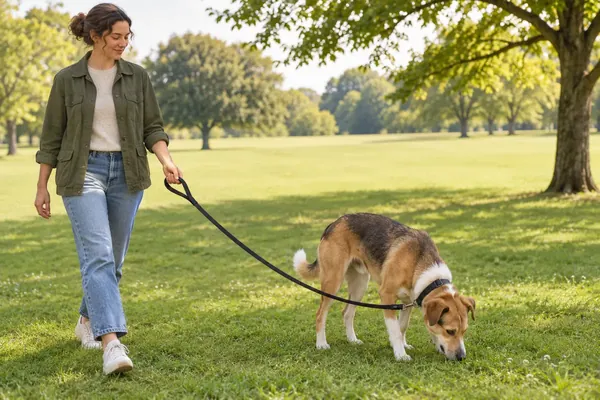
Compare three lead structures
Fixed-length clip lead. A separate clip attaches to a flat collar or a fitted harness. A short, predictable reach helps on pavements and near crossings. A collar carries the pull at the neck. A well-fitted harness is the better everyday choice for a dog that pulls, along with loose-lead training.
Slip lead. The braided rope slip lead has a loop that goes around the neck in place of a separate collar. The loop tightens under tension and can put pressure on the neck. Slip leads can be used for brief handling by trained staff. For routine walks, training or a dog that pulls, choose a clip lead with a fitted harness. Avoid jerking any lead.
Retractable lead. The line feeds from a handle and can lock at a chosen distance. More reach leaves less immediate control. A lunge at the end of the line can jerk the neck if it is clipped to a collar. Use a fixed-length lead near roads, crowds or other hazards. The classic retractable lead and shell-design retractable lead both list 3 m and 5 m options. The shell design also has a choice of a waste-bag accessory.
Check the grip, line and clip
Check a retractable lead’s lock while the dog is secure and the line is slack. Avoid grabbing a moving line and keep it from winding around hands, legs or the dog. Use a fixed-length clip lead when you need a reliably short working distance for training.
Check for damage at the clip, joining points and line. On a retractable model, check that the line returns smoothly and the stop works. Confirm equipment suitability for the dog and follow the exact model’s instructions.
Practise where your dog can pay attention
Start somewhere quiet. Reward your dog for walking near you with slack in the lead. When it tightens, pause calmly and wait for slack before moving again. Avoid jerking the lead. Work in short repetitions and give the dog sniffing breaks. Move farther from distractions if the dog struggles.
A comfortable collar or properly fitted harness can support the routine. Practise the short distance you use near hazards and give the dog times when it is free to sniff within a safe distance.
Compare samples before choosing a range
For a retail or group order, record the working length, colour and handle. Note whether the sample has a separate clip, an integrated neck loop or a retracting line with a lock. Use pet accessory sourcing resources to record dimensions and open questions.