
Grooming & Coat Care
How to choose a brush or comb for your pet’s coat
Look at the length of the outer hair, whether there is a dense undercoat and whether the animal is comfortable being touched where you want to brush. A tool that works for one cat or dog may feel unpleasant on another.
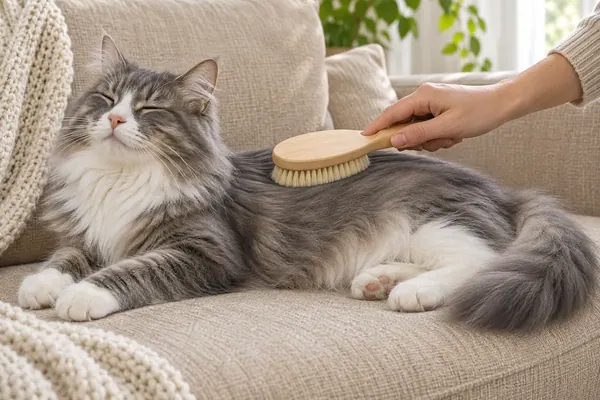
Match the grooming job to the coat
A soft brush or grooming mitt may be enough for a short-haired cat that tolerates light strokes. For a long coat, an appropriate comb can help check layers below the surface. Divide the coat into small sections and work gently in the direction of the hair. Leave dense mats for a qualified professional.
Dogs’ coats vary substantially. Ask what routine suits your dog before choosing a deshedding tool. Use it only on a coat free of tangles or mats and avoid repeated strokes over one spot. If the fur pulls or the skin moves with the tool, ease off and reassess.
Compare head shape and cleanup separately
The solid wood slicker brush is listed in Small, Medium and Large. Check the head dimensions and pin contact on a sample where they matter. The cat-ear self-cleaning slicker brush uses stainless steel pins with protective resin tips and a button to release collected hair. Check how the head feels on the coat before considering cleanup.
The curved-blade deshedding comb has one listed size of 11 × 6 × 2 cm. Compare its head with the area you can reach without dragging across skin. Ask a qualified groomer or vet if you are unsure which tool suits the coat.
| Tool | Listed features | What to check on the animal |
|---|---|---|
| Solid wood slicker brush | Wood and metal; Small, Medium or Large | Choose a head size that reaches the area comfortably. Keep pressure light. |
| Cat-ear self-cleaning slicker brush | Stainless steel pins, protective resin tips and a hair-release button | Try light strokes and check how the pins feel. The button only helps clear collected hair. |
| Curved-blade deshedding comb | Curved head; listed size 11 × 6 × 2 cm | Ask if it suits the coat. Use only on an untangled coat and avoid repeated strokes over one area. |
Make a short session easy to leave
Start where the animal already likes being touched. Let it see and sniff the tool, try one or two strokes and put the tool down. Tail flicking, skin rippling, pulling away and moving to leave can all be cues to stop. Build duration gradually while the animal stays comfortable.
Clear hair from the head and check for bent pins, sharp edges or loose parts. Look at the coat and skin in good light. Seek veterinary advice for unexpected lesions, pain or a sudden change in grooming behaviour.
Write down the coats you intend to serve
List the grooming jobs customers ask about, such as light brushing, combing a longer coat and removing loose undercoat when appropriate. Test a sample for grip, pin contact and cleanup. Compare the brush and comb category and record outstanding details before deciding what to stock.